Table of Contents
1. Introduction
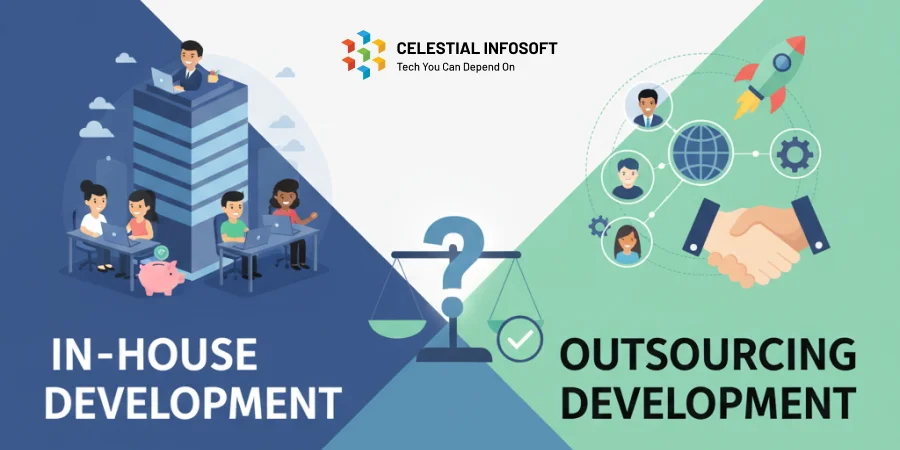
Every Chief Technology Officer (CTO) or Founder building a scalable product faces a fundamental decision: the software development dilemma. Should you invest months and millions building an internal team, or gain instant scalability by choosing to outsource software development?
In 2025, the debate over in-house vs outsourcing software development is no longer binary. The stakes are higher than ever, driven by rapidly evolving AI technologies, intense competition for niche talent (like specialized Python or IoT developers), and increased pressure to launch faster. Industry research consistently shows that complex IT projects are at high risk of failure, with nearly three-quarters of all major tech initiatives failing to achieve their desired results. This decision dictates your project’s cost, speed-to-market, long-term stability, and ultimate success.
This guide provides a strategic, data-backed analysis, offering the clarity needed to make the right choice for your business strategy in the current competitive environment.
2. Understanding the Three Approaches
Before comparing them, it’s vital to define the development models available to you.
What is In-House Software Development?
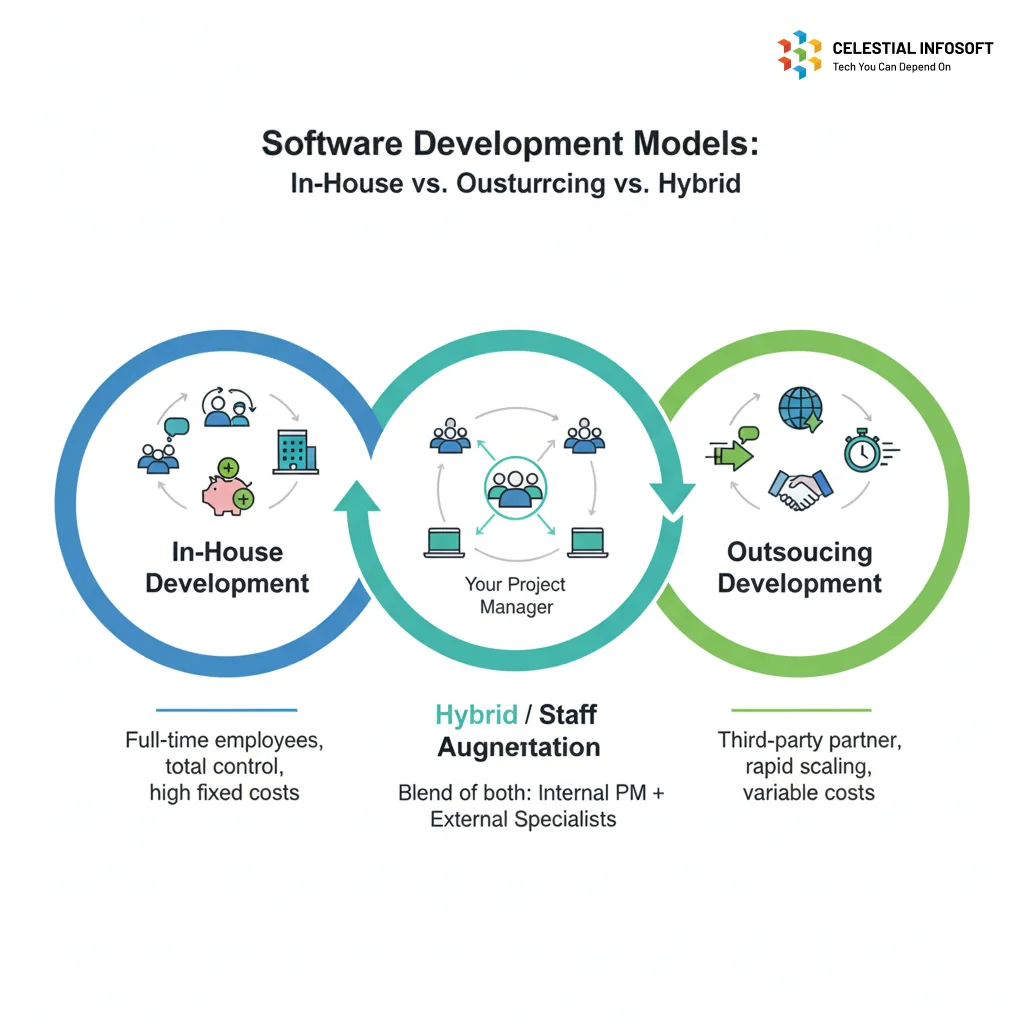
In-house development involves hiring full-time employees (FTEs) directly onto your payroll. These developers, designers, and project managers report to your internal leadership, work from your offices (or remotely on your terms), and are fully immersed in your company culture and IP.
What is Outsourcing Software Development?
Outsourcing involves contracting with a third-party specialized software development company to handle some or all of your project. This firm provides the necessary resources, developers, DevOps engineers, and QA specialists, and manages their performance, often delivering the work remotely.
The Rise of Hybrid Models
In today’s market, the “either/or” choice is often replaced by a flexible approach. The most popular hybrid model is Staff Augmentation. This means you hire developers from a third-party partner to temporarily fill specific skill gaps (e.g., adding three Node.js developers or one AI expert) to work directly under your existing in-house project manager. This model offers the best balance of speed and control.
3. Strategic Differences: In-House vs. Outsourcing
The impact of choosing one model over the other extends far beyond just salary. Strategic leaders evaluate these differences across key business metrics:
Cost Structure and Financial Risk Comparison
| Factor | In-House Model | Outsourcing/Partner Model |
| Financial Risk | High fixed costs (salaries, benefits, recruitment fees, severance). | Variable costs (pay for the defined scope or hours used). |
| Recruitment Overhead | Extremely high time and cost investment (4-6 months minimum per senior role). | Zero recruitment effort; talent is onboarded instantly. |
| Resource Scalability | Low agility; scaling up or down requires hiring/layoffs. | High agility; team size can be adjusted in weeks, not months. |
Timeline, Speed-to-Market, and Project Management
In-house teams have deep institutional knowledge, but their speed is constrained by recruitment and internal politics. Outsourcing partners excel in rapid time-to-market because they can dedicate a pre-vetted team to a project immediately. Outsourcing is often the fastest route for MVP (Minimum Viable Product) or urgent Legacy Modernization projects.
Talent Specialization & Access to Niche Expertise
This is the single greatest competitive advantage of outsourcing. You are not just hiring developers; you are buying expertise. Trying to hire a full-time, specialized Blockchain Developer or an expert in FastAPI performance is challenging and expensive globally. A strategic partner already has this talent pool. Your internal team can focus on the core product vision, while the outsourced partner delivers the niche, complex components.
Quality Control, Compliance, and Communication Gap Analysis
In-house teams offer seamless communication and cultural alignment. Outsourcing requires rigorous vendor management. Top-tier partners mitigate this with established processes: dedicated project managers, shared use of tools like Jira and Slack, and guaranteed Service Level Agreements (SLAs). For compliance-critical industries (like FinTech or Healthcare), look for partners with certified compliance protocols (e.g., [External link: ISO 27001 Certification]).
4. Advantages and Disadvantages (Balanced View for Trust)
A transparent assessment of both models is crucial for a trustworthy decision.
✅ Pros of In-House Software Development
- Deep Cultural Fit: The team is fully integrated with your company’s values and mission.
- Maximum Control: Full oversight over every architectural decision and daily workflow.
- Total IP Ownership: Immediate and undisputed control over all intellectual property.
- Institutional Knowledge: Knowledge is retained internally over many years.
❌ Cons of In-House Software Development
- Slow Scalability: Takes months to hire, onboard, and grow a specialized team.
- High Fixed Cost: Significant long-term financial commitment regardless of workload.
- Talent Scarcity: Extreme difficulty hiring niche experts in competitive local markets.
✅ Pros of Outsourcing Software Development
- Immediate Access to Talent: Onboard a highly specialized team (e.g., IoT Developers) in weeks.
- Cost-Efficiency: Eliminates recruitment, benefits, equipment, and office overhead.
- Focus on Core Business: Frees internal teams and leadership to focus on strategy and product vision.
- Global Best Practices: Gain immediate access to international experience, modern DevOps pipelines, and refined processes.
❌ Cons of Outsourcing Software Development
- Potential Communication Gaps: Requires careful management of time zone and cultural differences.
- Vendor Dependence Risk: Requires clear contract clauses regarding IP transfer and code documentation.
- Less Direct Control: Day-to-day work is managed by the vendor’s team lead.
5. Financial Deep Dive: Which Is More Affordable in 2025?
While hourly rates for outsourced developers may seem lower, the true comparison lies in the Total Cost of Ownership (TCO) over a three-year lifecycle.
The primary difference is the cost structure:
- In-House: Dominated by expensive fixed costs (salary, benefits, taxes, tools, office space) and massive hidden costs (recruitment fees, training, employee churn).
- Outsourcing: Dominated by a flexible service fee, which bundles all non-coding costs (HR, IT, office).
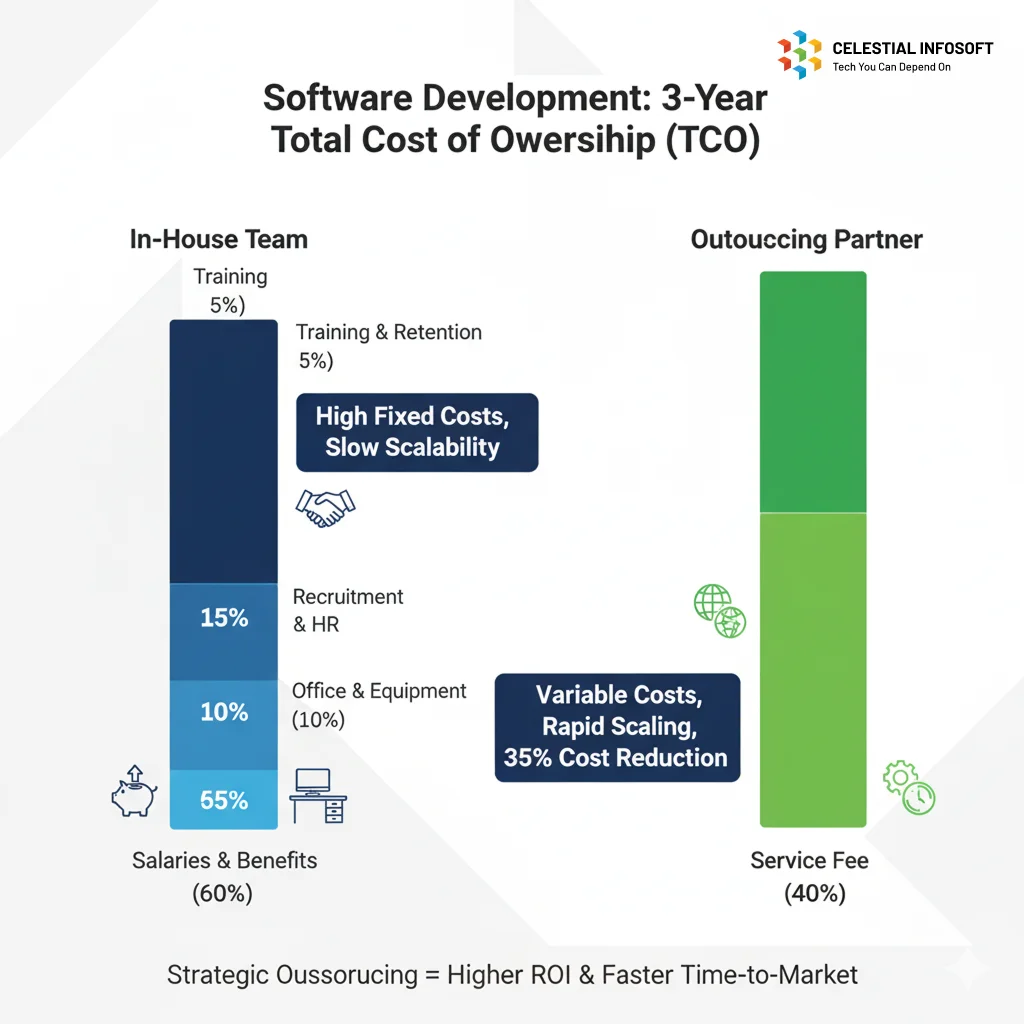
The Verdict: Outsourcing is overwhelmingly more affordable for projects with undefined long-term scopes, initial MVPs, or when niche expertise is needed temporarily, as it bypasses the massive fixed costs and retention risks associated with hiring.
6. When to Choose In-House Development
Choosing in-house is a strategic investment in institutional longevity.
Ideal Scenarios:
- Core IP/Secret Sauce: If the software is your single, unique competitive advantage, and must be constantly protected.
- High Regulatory Sensitivity: When frequent, direct, and immediate collaboration on sensitive security protocols (e.g., a bank’s core trading system) is non-negotiable.
- Established Processes: Large enterprises with the budget and time to attract and retain elite, full-time talent for 5+ years.
7. When to Choose Outsourcing (Your Primary Solution)
Outsourcing is the mechanism for agility and scale. It’s about buying time and specialized capability.
Common Use Cases:
- Accelerating MVPs: Get a product to market in 3-6 months.
- Filling Skill Gaps: Need expertise in AI/ML, Flutter, or complex Cloud infrastructure that you can’t afford to hire full-time.
- Legacy System Modernization: Using experienced Java or .NET teams to upgrade old systems while your core team focuses on new features.
- Staff Augmentation: Rapidly scaling up development power for a sudden spike in workload or new feature rollouts.
Risks and How to Mitigate Them:
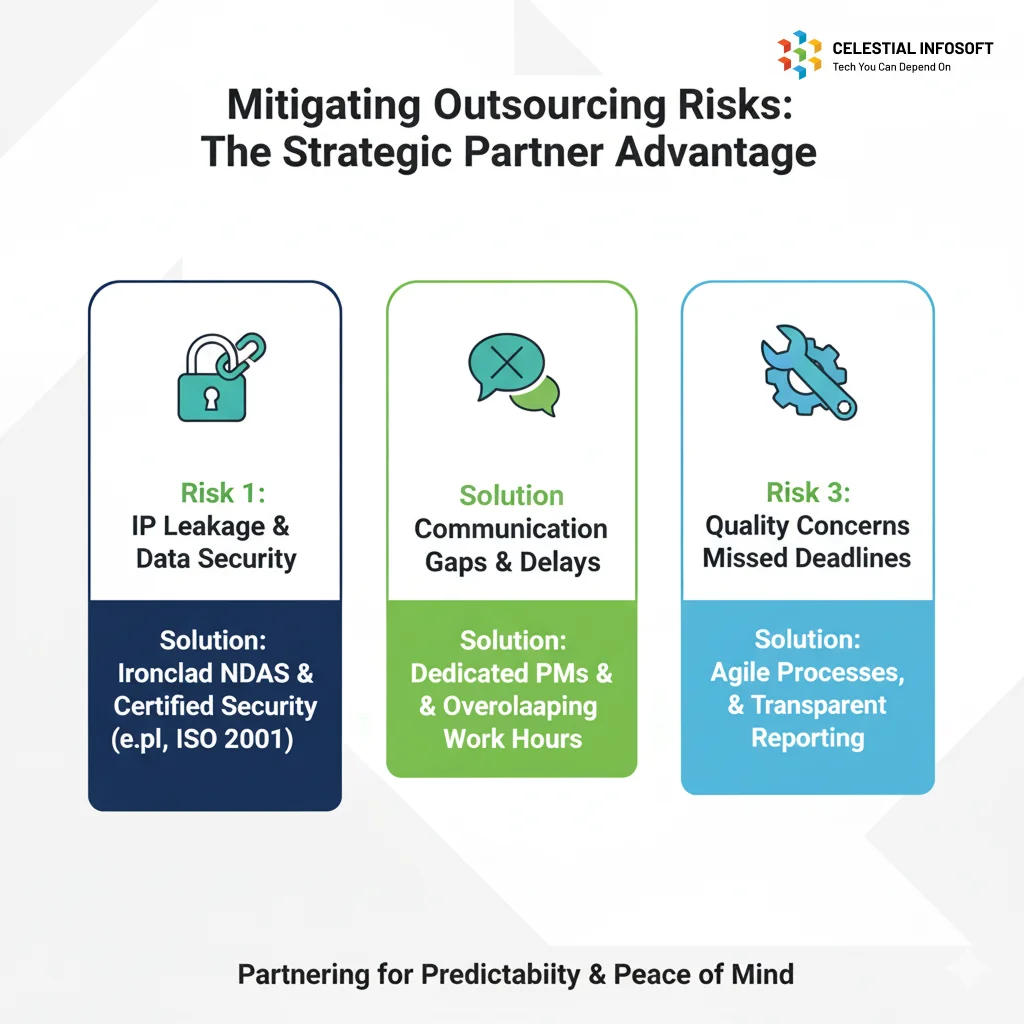
The primary risk is a loss of control or poor communication. Top-tier development companies mitigate this by providing 24/7 dedicated account managers, documented development processes (Agile/Scrum), and transparent reporting. For security risks, always demand ironclad NDAs and IP Transfer agreements.
8. Hybrid Development: The Best of Both Worlds
For many mature businesses, the hybrid model offers maximum control and flexibility.
How Companies Combine Both Models:
- In-House: Retains core strategic leadership (CTO, VP Engineering, Product Managers) who own the vision and design.
- Outsourced (Staff Augmentation): Contracts dedicated external engineers (Python Developers, DevOps Engineers) to execute the day-to-day coding tasks, directed by the internal PMs.
Case: Real Hybrid Success Story
A FinTech startup needed to build a highly scalable, compliant trading platform. They used their in-house team for regulatory compliance and core trading logic architecture. They augmented this team with five Remote Node.js developers and one DevOps Engineer hired from a strategic partner. This hybrid approach allowed them to cut the launch timeline by 40% while maintaining absolute control over the highly sensitive IP.
9. Expert Insights: What CTOs and Founders Recommend
Current industry trends overwhelmingly favor a flexible, cloud-native approach supported by specialized external talent.
A recent industry report revealed that the demand for outsourcing specialized services like AI/ML integration and DevOps automation has increased by 30% in the last year alone. CTOs are realizing that hiring is too slow and too risky for these dynamic, niche skills.
The Key Recommendation: Focus internal resources on building features that define your brand. Outsource complexity, scale, and specialization. This “build what differentiates, buy what standardizes” philosophy boosts EEAT (Expertise, Experience, Authority, Trust) by integrating world-class talent rapidly.
10. Strategic Partner Vetting: A CTO’s Checklist
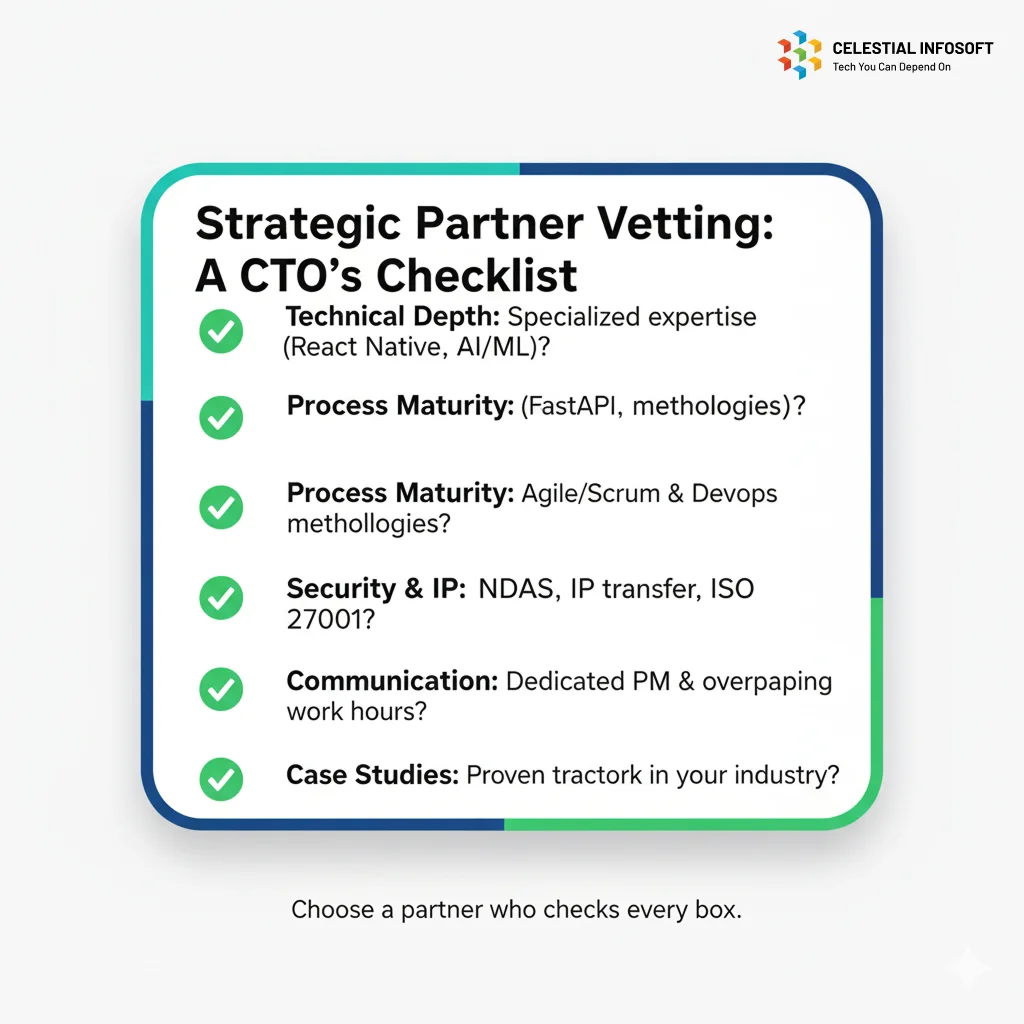
Choosing a development partner is a crucial executive decision. Use this checklist during your initial vetting to ensure a reliable outcome.
| Vetting Factor | Must-Have Checkpoint | Purpose |
| Technical Depth | Specialized expertise (e.g., certified FastAPI or React Native developers)? | Confirms they can solve complex problems. |
| Process Maturity | Clearly defined, measurable Agile/Scrum and DevOps methodologies? | Ensures predictable timelines and quality. |
| Security & IP | Signed NDAs, clear IP transfer policy, and compliance track record (e.g., GDPR)? | Mitigates legal and financial risk. |
| Communication | Guaranteed overlapping work hours/dedicated project manager in your time zone? | Reduces the communication gap risk. |
| Case Studies | Proven, published success stories in your industry (e.g., FinTech, E-commerce)? | Verifies experience and real-world results. |

11. FAQs
Is outsourcing software development cheaper?
Yes, generally. While hourly rates vary, outsourcing significantly reduces the Total Cost of Ownership (TCO) by eliminating fixed costs like salaries, benefits, recruitment fees, and employee churn associated with in-house teams.
What are the main risks of outsourcing?
The main risks are intellectual property (IP) leakage, communication challenges due to cultural or time zone differences, and potential vendor dependency. These risks are mitigated by rigorous contract vetting, using partners with clear communication protocols, and maintaining strong internal project management.
Why do startups prefer outsourcing?
Startups overwhelmingly prefer outsourcing because it allows them to achieve product-market fit faster. They can instantly access a full development stack (backend, mobile, cloud) without spending 6-12 months on high-risk, expensive recruitment.
Which model is better for long-term growth?
The Hybrid Model is often superior for long-term growth. It combines the strategic control and cultural alignment of a small in-house core team with the scalable, specialized execution power provided by an outsourced partner.
Can I combine in-house and outsourcing models?
Absolutely. Combining them through a Staff Augmentation model is a popular strategy for agility. You keep your core team focused on strategic tasks while temporarily adding outsourced specialists to accelerate feature delivery or address specific technical debt.
12. Conclusion
The decision between in-house and outsourcing software development is ultimately about risk and speed. In the fast-moving digital economy of 2025, waiting for the perfect in-house team is a risk few can afford. Strategic businesses are shifting their mindset from simply hiring developers to acquiring specialized, scalable development capacity.
By strategically leveraging outsourcing for scale and niche expertise (like AI/ML or Python backend development), you can cut time-to-market, reduce financial overhead, and ensure world-class specialists build your product.
Ready to architect a scalable solution without the hiring headache?