Introduction
The decision to outsource software development is one of the most significant strategic choices a company makes, driven by the need for specialized talent and the desire for cost efficiency. The market is vast and highly varied: hourly rates span from $15 per hour to over $180 per hour globally.
Navigating this enormous range requires more than simply finding the lowest bid; it demands understanding the Total Cost of Ownership (TCO). This guide moves beyond simple hourly rates to detail who should outsource, why, and crucially, the strategic steps to ensure you maximize your budget without sacrificing code quality or speed.
Table of Contents
What is Software Development Outsourcing?
Software development outsourcing is the practice of contracting out technology-related work to an external third-party service provider. This strategy helps organizations leverage global resources to fill talent gaps and manage costs.
The method of outsourcing is categorized by location:
- Offshoring: Partnering with an Offshore software development team in a distant location (e.g., a US company working with a team in India). Typically offers the highest cost savings.
- Nearshoring: Partnering with a team in a nearby country or time zone (e.g., a US company working with a team in Latin America). Offers a balance of savings with strong time-zone overlap.
- Onshoring: Partnering with a vendor in the same country. Offers the closest cultural and time-zone alignment, but with the highest rates.

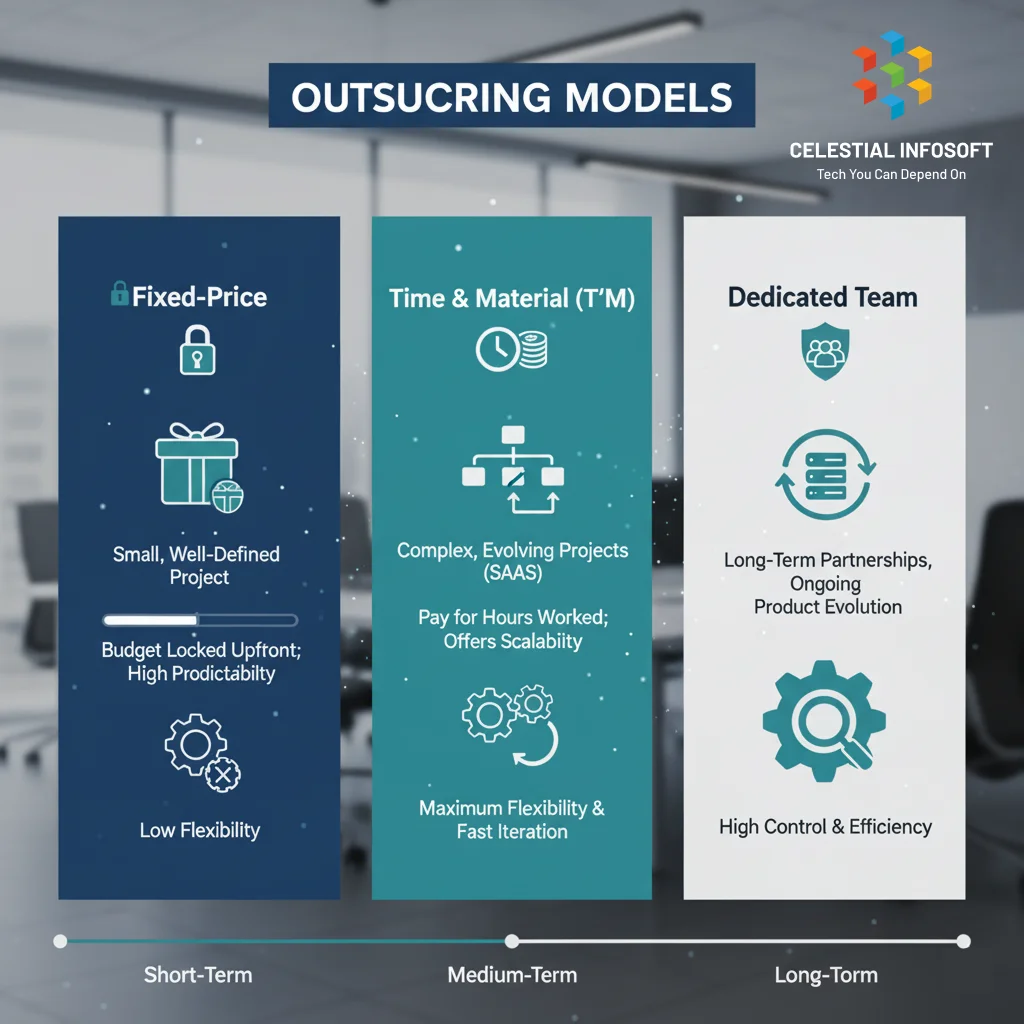
Outsourcing Models Explained:
| Model | Ideal Project Type | Cost Structure | Flexibility & Control |
| Fixed-Price | Small, well-defined MVPs or prototypes. | Budget is locked upfront; high predictability. | Low flexibility; changes are slow and expensive. |
| Time & Material (T&M) | Complex, evolving projects (SaaS). | Pay for the hours worked; offers scalability. | Maximum flexibility and fast iteration. |
| Dedicated Team | Long-term partnerships, ongoing product evolution. | Fixed monthly cost per team member. | High control and efficiency for continuous work. |
The Strategic Advantages of Outsourcing
Modern outsourcing is a strategic accelerator, not just a cost-cutting measure:
- Access to Global Talent: Bypass local skill shortages to access specialized expertise (e.g., specific AI/ML frameworks, niche security compliance) instantly.
- Significant Cost Reduction: Eliminating the operational costs of in-house staff (recruitment, benefits, taxes, office space) can reduce a company’s development TCO by 30% to 60%.
- Accelerated Time-to-Market: Quickly scale a team from two to ten developers in weeks, dramatically speeding up product delivery cycles.
- Focus on Core Business: Freeing your in-house CTOs and developers to focus on strategic, revenue-generating initiatives.
Who Should Outsource Software Development (And When)?
| Condition | Your Solution |
| Budget Control is Key | You need high-quality expertise, but local rates ($120+/hr) exceed your TCO budget. |
| Skills Gap | You need high-quality expertise, but local rates ($120+/hr) exceed your TCO budget. |
| Need for Rapid Scale | You need to ramp up a full development team immediately to hit an aggressive market deadline. |
| Project is Not Core | The application is vital (like an internal tool), but its development is not your primary business focus. |
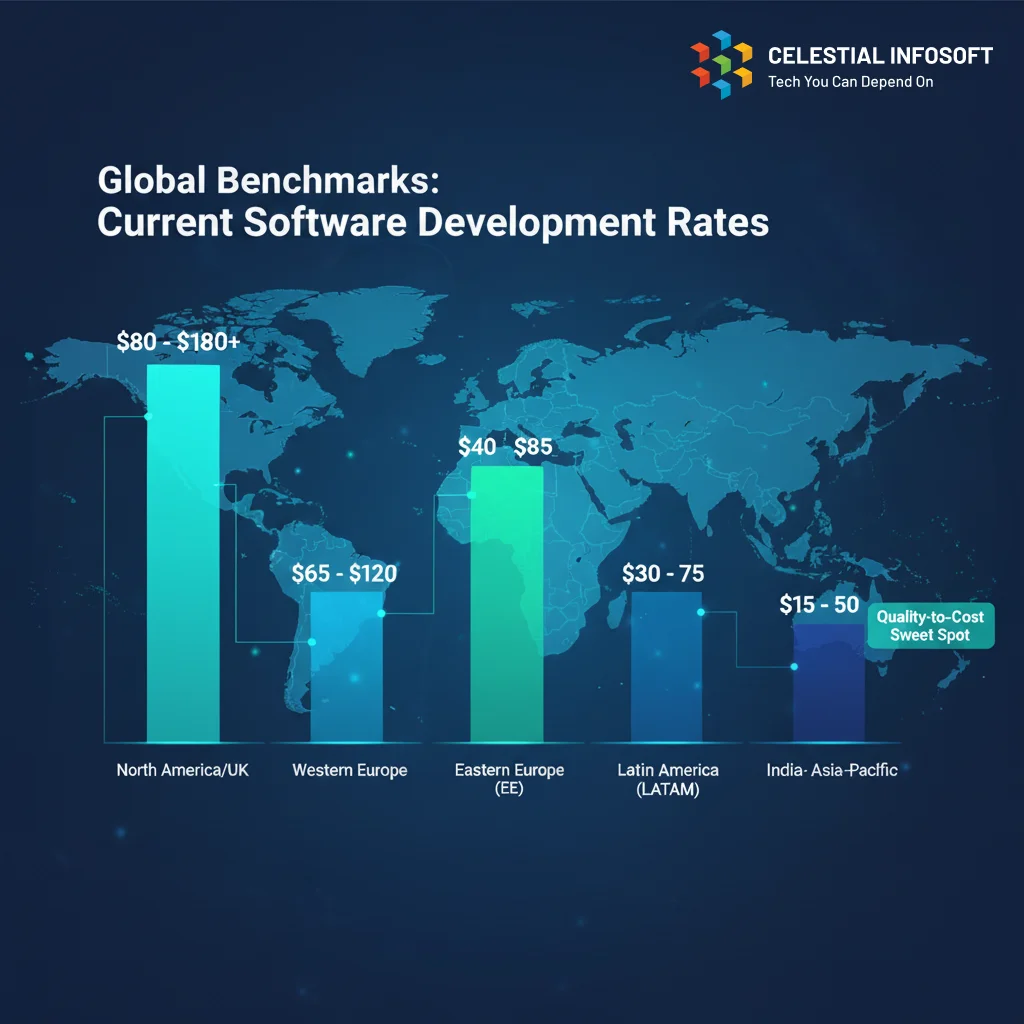
Global Benchmarks: Current Software Development Rates
The overall project cost can range from $10,000 for a simple project to over $500,000 for a complex enterprise platform. The key variable is the developer’s hourly rate, driven by geography.
Quick Summary: Global Hourly Rate Benchmarks (Mid-Level Developer)
| Region | Typical Hourly Rate (USD) | Primary Outsourcing Draw |
| North America/UK | $80 – $180+ | Onshore, high quality, maximum collaboration. |
| Western Europe | $65 – $120 | High quality, strong legal compliance. |
| Eastern Europe (EE) | $40 – $85 | Best quality-to-cost ratio, strong technical talent. |
| Latin America (LATAM) | $30 – $75 | Nearshore for the US, good time zone alignment. |
| Asia-Pacific (APAC) | $15 – $50 | Most cost-effective, largest talent pool (India). |
Detailed Rates by Seniority, Role, and Region
Costs for a full development team are complex and include salaries for all roles, from the Project Manager (PM) to the QA Engineer.
| Role/Region | Eastern Europe ($/hr) | Latin America ($/hr) | Asia-Pacific ($/hr) |
| Junior Developer (0-2 Yrs) | $25 – $35 | $18 – $35 | $12 – $25 |
| Mid-Level Developer (2-5 Yrs) | $35 – $50 | $35 – $60 | $20 – $40 |
| Senior Developer (5+ Yrs) | $55 – $85+ | $50 – $85+ | $45 – $80+ |
| Project Manager | $50 – $85 | $40 – $70 | $20 – $45 |
| QA/Manual Tester | $30 – $50 | $25 – $40 | $20 – $35 |
To benchmark market expectations, consult reliable sources for Global Developer Salary Trends in the tech industry.
Cost by Project Complexity and Scope
The total estimated cost is a function of complexity. Simple projects require small teams for a short time; complex projects require large, senior-heavy teams for a year or more.
| Project Type | Average Timeline | Estimated Total Cost (USD) |
| Simple (Landing Page, Basic API) | 4 – 8 Weeks | $10,000 – $40,000 |
| Medium (MVP App, SaaS Prototype) | 3 – 6 Months | $40,000 – $150,000 |
| Complex (Enterprise Platform, Custom CRM) | 6 – 12+ Months | $150,000 – $500,000+ |
If your focus is mobile, the cost structure is slightly different. See our specialized guide: How Much Does It Cost to Hire an App Developer?
Strategic Cost Management: Value, Risk, and ROI
Hidden Costs That Can Sink Your Outsourcing Budget
The most common trap is focusing only on the lowest hourly rate. Smart companies budget for these unseen costs:
- Rework and Technical Debt: This is the future cost incurred by making technical compromises today. Choosing a vendor based purely on the lowest hourly rate often leads to low-quality code, forcing expensive rework. Unmanaged technical debt can absorb 20% to 40% of a project’s long-term budget.
- Communication & Time Zone Overhead: If there is minimal time-zone overlap, daily check-ins become difficult. This managerial overhead leads to delays, increased confusion, and higher internal management costs.
- Legal & IP Fees: The cost of hiring legal counsel to ensure ironclad NDAs, contracts, and secure Intellectual Property (IP) transfer in foreign jurisdictions.
- Vendor Switching Costs: If the initial partnership fails, the cost of re-scoping, knowledge transfer, and hiring a new team can be disastrously high.
How to Reduce Your Development Cost and Maximize ROI
The best strategy is to find a partner that delivers quality code that minimizes technical debt, which is the ultimate long-term cost reducer.
- Tip 1: Define the Scope: Implement strict change management protocols to avoid scope creep, the biggest budget killer. Lockdown requirements before development begins.
- Tip 2: Prioritize Alignment over Rate: Choose a region that offers cost savings and sufficient time-zone overlap for daily, real-time collaboration. Frictionless communication saves more money than a $5 difference in hourly rate.
- Tip 3: Seek the Quality/Cost Sweet Spot (The Celestial Advantage)
- The optimal decision is to find a partner that balances a Vast Talent Pool, Highly Competitive Rates, and Proven Quality Work. This usually means looking to mature outsourcing hubs (like those in Eastern Europe or certain APAC regions) known for high engineering standards.
- By combining rigorous quality assurance processes with access to global, top-tier engineering talent, we ensure you receive a low-debt solution at a rate highly competitive against US/Western European onshore options. We focus on TCO, not just hourly rate, making us the strategic choice for companies looking to maximize their budget without traditional offshore risks.

The Strategic Alternative: Outsourcing vs. In-House TCO
For many companies, the true cost difference only appears when comparing TCO. Outsourcing eliminates fixed costs like recruitment, benefits, and office space, converting them into flexible, variable costs.
For a full financial breakdown of the alternatives, including long-term employee costs, read our comprehensive TCO analysis: CTO’s Guide to In-House vs Outsourcing Software Development
Essential Questions to Ask Before Outsourcing (Due Diligence)
- IP & Security: What is your standard process for transferring and securing our Intellectual Property (IP)?
- Quality Assurance: How do you ensure code quality and maintainability (Do you use automated testing, CI/CD, and code reviews)?
- Risk Mitigation: What are your contingency plans for unexpected events (e.g., key developer leaving)?
- Cultural Fit: How do you manage time-zone overlap to ensure seamless daily communication?

Key Takeaways and Next Steps
Conclusion
The cost of outsourcing software development is a solvable equation. The most successful businesses are not those that found the cheapest developer, but those that found a partner capable of delivering a low-debt, high-capacity solution efficiently. By leveraging current market benchmarks, defining your scope clearly, and prioritizing quality, you ensure that outsourcing is not a risk, but a powerful engine for business growth.
Frequently Asked Questions (FAQ)
Is outsourcing IT cheaper than hiring in-house?
Yes, typically. When factoring in the Total Cost of Ownership (TCO), outsourcing can save companies 30% to 60% compared to a full-time employee due to the elimination of overhead and benefit costs.
What is the average hourly rate for a software developer?
The global range is $15 to $180+ per hour. The optimal zone for high-quality and competitive rates (Eastern Europe/LATAM) falls between $40 and $85 per hour.
What is the best outsourcing model for a startup MVP?
The Fixed-Price model is often recommended initially to ensure the budget is contained and the scope is rigid, minimizing financial risk for an early-stage product.
Which region has the best quality-to-cost ratio?
The Asia Region (e.g., India) is widely recognized for offering the single best return on investment due to the combination of the world’s largest technical talent pool, high English proficiency, and unparalleled cost advantages.